Blog
Color Doppler vs Ultrasound Machine: What’s the Difference?

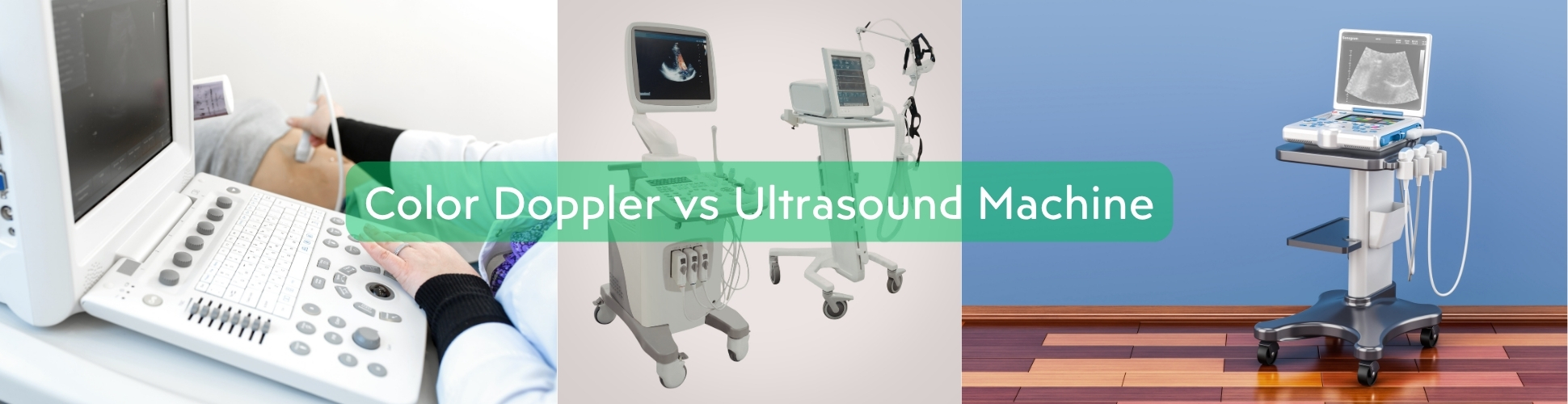
When doctors and clinic owners search for color doppler vs ultrasound machine, they want a clear, practical answer: which system delivers the diagnostics their patients actually need — and which one justifies the investment.
A standard (normal) ultrasound machine produces high-resolution grayscale images of tissue structure. A color Doppler machine does the same — plus real-time color mapping of blood flow direction and velocity. Both use high-frequency sound waves, but only Color Doppler applies the Doppler principle to moving blood cells.
This guide breaks down the technical and clinical differences so doctors, radiologists, and clinic buyers can make confident purchasing decisions.
What Is a Normal Ultrasound Machine?
A normal ultrasound machine (also called B-mode or grayscale ultrasound) sends sound pulses into the body and displays returning echoes as shades of gray.
- Strong echoes (bone, stone) = white
- Weak echoes (fluid) = black
- Soft tissue = varying grays
It excels at anatomy: fetal biometry, gallstones, ovarian cysts, liver lesions, and abdominal organ measurements. Most entry-level and portable ultrasound machines are grayscale-only or have very basic Doppler if any.
What Is Color Doppler Ultrasound?
Color Doppler ultrasound overlays color information on the grayscale image using the Doppler effect. Red usually indicates flow toward the probe; blue indicates flow away. The shade and brightness show velocity.
Modern color Doppler machines combine:
- B-mode (grayscale anatomy)
- Color flow mapping
- Spectral (pulse-wave) Doppler for velocity waveforms
- Often Power Doppler (more sensitive to slow/low-volume flow)
This turns a static picture into a dynamic functional study.
Key Differences: Color Doppler vs Ultrasound Machine
| Feature | Normal Ultrasound Machine | Color Doppler Machine |
|---|---|---|
| Primary Output | Grayscale anatomy only | Grayscale + real-time color blood flow |
| Blood Flow Detection | Not possible | Direction, velocity, turbulence |
| Typical Price Range (2026, Pakistan) | ₨280,000 – ₨600,000 (portable models) | ₨650,000 – ₨3,500,000+ (portable to cart-based) |
| Processing Power | Lower | Higher |
| Best For | Routine anatomy scans | Vascular, high-risk pregnancy, cardiac, abdominal |
Quick takeaway: Every Color Doppler machine can perform normal ultrasound scans. The reverse is not true.
Clinical Applications: Where the Difference Matters
1. Vascular Studies
Color Doppler is the gold standard. It instantly shows carotid plaque with stenosis, DVT, varicose vein reflux, AV fistulas, and peripheral arterial disease. Normal ultrasound can only see vessel walls — not whether blood is moving or blocked.
2. Pregnancy & Obstetrics
Routine first-trimester and anomaly scans use normal ultrasound. But color Doppler becomes essential for:
- Umbilical artery & middle cerebral artery Doppler (fetal growth restriction)
- Uterine artery PI/RI for preeclampsia screening
- Placental vascularity and twin-twin transfusion assessment Most guidelines (ISUOG, ACOG) now recommend Doppler in high-risk pregnancies.
3. Cardiology
Color Doppler visualizes valvular regurgitation jets, shunts, and ventricular septal defects in seconds. Spectral Doppler then quantifies severity. Basic ultrasound shows chamber size and wall motion but misses flow abnormalities.
4. Abdominal Imaging
Liver cirrhosis, portal hypertension, renal artery stenosis, and aortic aneurysms all require flow information. Color Doppler detects reversed portal flow or renal vein thrombosis that grayscale alone cannot.
5. Gynecology
Color Doppler helps differentiate benign vs malignant ovarian masses (via vascularity patterns), confirms endometrial polyps, and assesses uterine fibroid blood supply before embolization or myomectomy.
When Should a Clinic Invest in a Color Doppler Machine?
Upgrade to Color Doppler if your clinic handles any of these:
- Vascular or venous insufficiency referrals
- High-risk obstetrics or infertility workups
- Cardiology or echo referrals
- General abdominal scans where vascular complications are common (diabetes, hypertension, liver disease)
Stick with normal ultrasound if:
- You only do routine pregnancy scans, basic abdominal, or musculoskeletal imaging with no vascular component
- Budget is extremely tight and volume is low
ROI reality: A good color Doppler machine for clinic pays for itself faster because you can bill higher-value studies (CPT codes for Doppler exams) and reduce referrals to hospitals. Most mid-level clinics recover the extra cost within 12–18 months.
Advantages of Choosing a Color Doppler System
- More accurate diagnosis in one visit
- Better patient outcomes (earlier detection of vascular issues)
- Higher reimbursement per scan
- Future-proof: most manufacturers now make Color Doppler the default mid-range model
- Portable Color Doppler options (laptop-style or tablet) fit small clinics perfectly
FAQs
Q1: Is Color Doppler the same as Doppler ultrasound?
No. “Doppler ultrasound” is the broad category. Color Doppler is the visual color-overlay version; spectral Doppler gives waveforms and numbers.
Q2: Can a normal ultrasound machine detect blood flow?
No. It shows anatomy only. Without Doppler capability it cannot measure or display flow.
Q3: What is color Doppler ultrasound used for in pregnancy?
It assesses placental and fetal blood flow to detect growth restriction, preeclampsia risk, and cord abnormalities.
Q4: Are Color Doppler machines much more expensive?
Yes — typically 1.5–3× the price of basic grayscale units — but the added diagnostic power and billing codes justify it for most busy clinics.
Q5: Do I need special training to use Color Doppler?
Basic operation is similar, but accurate interpretation of flow patterns requires additional hands-on training (most manufacturers include it).
Q6: Is Power Doppler better than Color Doppler?
Power Doppler is more sensitive for very slow flow or tiny vessels but does not show direction. Most clinics choose full Color + Power + Spectral systems.