Blog
Portable vs Console Ultrasound Machine: Which One Is Better for Your Clinic?

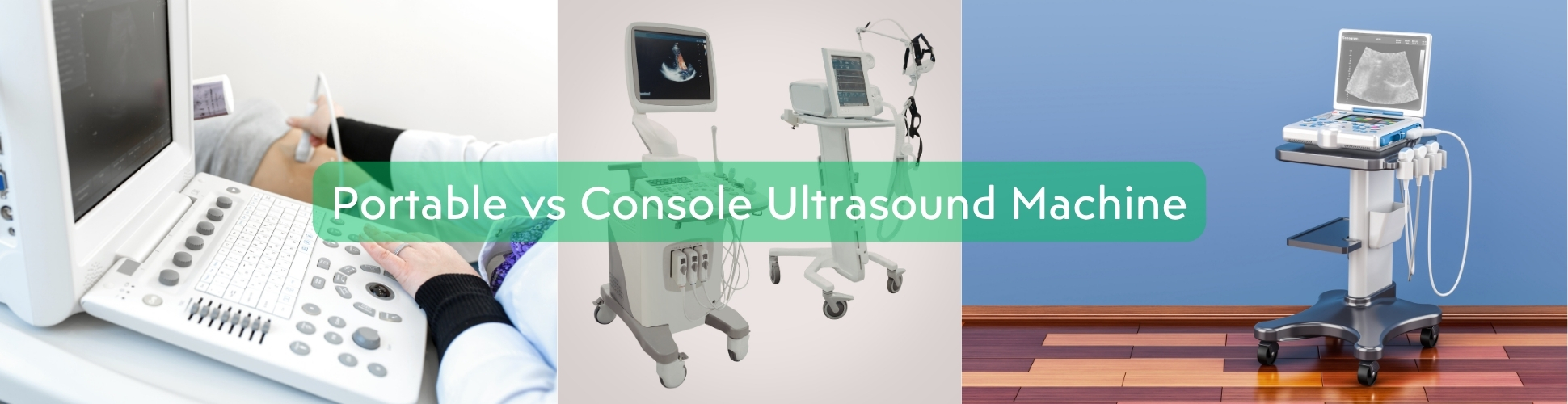
Choosing the right ultrasound system is one of the most important equipment decisions a clinic or hospital can make. With portable ultrasound machine and console ultrasound machine (also called cart-based ultrasound machine) options now more advanced than ever, the question “which ultrasound machine is better” no longer has a one-size-fits-all answer.
This guide breaks down the real-world differences in portability, imaging capability, workflow, room setup, specialties, budget, upgrade options, and patient volume — so you can match the machine to your exact clinical needs.
Quick Comparison Table: Portable vs Console Ultrasound Machine
| Feature | Portable Ultrasound Machine | Console / Cart-Based Ultrasound Machine |
|---|---|---|
| Portability | Excellent (2–8 kg, battery-powered) | Poor (80–150+ kg, requires cart & dedicated space) |
| Imaging Quality | Very good (modern AI-enhanced models) | Superior (larger transducers, deeper penetration, advanced modes) |
| Workflow Speed | Fast setup & bedside use | Slower setup but faster high-volume scanning |
| Room Setup | Minimal – any room, clinic, ambulance, or field | Dedicated ultrasound suite required |
| Best Specialties | POCUS, emergency, OB/GYN, anesthesia, rural clinics | Radiology, cardiology, high-volume OB, vascular |
| Upfront Cost | $8,000 – $35,000 | $25,000 – $120,000+ |
| Upgrade Flexibility | Limited (software & probe swaps) | High (modular hardware & software) |
| Daily Patient Volume | Best for low-to-medium (≤15–20 scans/day) | Ideal for high-volume (30+ scans/day) |
1. Portability & Mobility
Portable ultrasound for clinic use wins hands-down. Most weigh under 6 kg, run on rechargeable batteries for 2–6 hours, and fit in a backpack or on a compact trolley. Ideal for:
- Multi-room clinics
- Home visits
- Emergency departments
- Rural or mobile health camps
Console machines are cart-based and designed to stay in one room. They offer larger monitors and more stable platforms but cannot be easily moved between floors or facilities.
2. Imaging Capability & Diagnostic Accuracy
Console ultrasound machines still deliver the highest resolution, especially in:
- Deep abdominal & pelvic imaging
- Cardiac strain & 3D/4D echocardiography
- Advanced Doppler and elastography
However, 2025–2026 portable models (with AI noise reduction and high-frequency linear probes) have closed the gap dramatically for most routine scans. For 80–85 % of general clinic needs, modern portable systems provide clinically comparable images.
3. Workflow & Daily Efficiency
- Portable: Plug-and-play in under 30 seconds. Perfect for quick bedside scans and point-of-care ultrasound (POCUS).
- Console: Longer boot-up and probe selection but faster processing for complex studies with multiple views.
High-volume departments prefer console systems because technologists can move quickly from one detailed exam to the next without repositioning equipment.
4. Room Setup & Infrastructure Needs
Portable machines need almost nothing — a power outlet or battery is enough. Console machines require:
- A dedicated ultrasound room
- Stable power supply
- Space for the cart and probe holders
- Often a height-adjustable table and printer
Small clinics and start-ups save thousands by choosing portable systems and avoiding renovation costs.
5. Best Use Cases
Best Use Cases for Portable Ultrasound Machines
- Small to mid-sized clinics with 1–3 exam rooms
- Emergency & critical care departments
- OB/GYN practices offering mobile antenatal scans
- Anesthesia & pain management (nerve blocks, vascular access)
- Rural health centers and telemedicine outreach
- Veterinary clinics (many models are dual-purpose)
Best Use Cases for Console Ultrasound Machines
- Hospital radiology or imaging departments
- High-volume cardiology or vascular labs
- Large OB/GYN clinics performing 30+ scans daily
- Teaching hospitals needing advanced teaching modes
- Facilities performing specialized studies (contrast-enhanced, fusion imaging)
6. Budget & Long-Term Value
Portable ultrasound machines have a lower entry price and faster ROI for growing or budget-conscious clinics. Console machines cost more upfront but often last 8–12 years with regular maintenance and can be upgraded more extensively.
Factor in:
- Maintenance contracts
- Probe replacement costs
- Training time for staff
7. Upgrade Options & Future-Proofing
Console systems are more modular — you can add new transducers, software packages, or even AI modules years later. Portable systems usually rely on firmware updates and new probe compatibility, though many manufacturers now offer trade-in programs that make upgrading easier.
Practical Decision-Making Advice: How to Choose
Follow this 5-step checklist:
- Calculate daily scan volume — Under 20 scans/day → lean portable. Over 25 → consider console.
- List your top 3 specialties — If you need advanced cardiac or deep abdominal work, console may be worth the investment.
- Measure your space — No dedicated room? Portable is the only realistic option.
- Set a realistic budget — Include probes, warranty, and training.
- Think 3–5 years ahead — Will your practice grow or add new services?
Many clinics now start with a high-end portable model and add a console later as volume increases — a smart phased approach.
FAQs: Portable vs Console Ultrasound Machine
Q1: Are portable ultrasound machines as accurate as console models?
Modern portable systems are highly accurate for 80–90 % of routine scans. Console machines still hold the edge for highly specialized or deep-tissue imaging.
Q2: Which ultrasound machine is better for a small clinic?
A portable ultrasound machine is almost always the better choice for clinics with limited space and moderate patient volume.
Q3: How long do portable ultrasound machines last?
With proper care, 5–8 years. Console machines typically last 8–12 years.
Q4: Can I use a portable ultrasound machine for cardiology?
Yes — many current portable models include excellent phased-array probes and color Doppler suitable for basic cardiac and vascular work.
Q5: Do console machines offer better resale value?
Generally yes, because of their longer lifespan and upgradeability, but high-quality portable units also retain strong resale value.
Q6: Is there a hybrid option?
Some premium portable systems now offer cart docking stations, giving you the best of both worlds.